Learn how to get started creating a workstation with Cloud Workstations.
A *workstation* is a preconfigured development environment that administrators
or platform teams define in a *workstation configuration* . The workstation
configuration includes the container image used by the workstation. Your
administrators choose whether to use one of the Cloud Workstations
[preconfigured base images](https://docs.cloud.google.com/workstations/docs/preconfigured-base-images)
or whether to provide a reference to a
[customized container image](https://docs.cloud.google.com/workstations/docs/customize-container-images).
*** ** * ** ***
To follow step-by-step guidance for this task directly in the
Google Cloud console, click **Guide me**:
[Guide me](https://console.cloud.google.com/?journey_id=workstations--set-up--intro&walkthrough_id=workstations--set-up--launch)
*** ** * ** ***
### Before you begin
Before you begin using Cloud Workstations, be sure that you have the
[required permissions](https://docs.cloud.google.com/workstations/docs/access-control#enable_required_roles)
and that you complete these required setup steps.
You can skip this section if you've already completed this setup.
1.
Enable the Cloud Workstations API, if it is not already enabled.
**Roles required to enable APIs**
To enable APIs, you need the `serviceusage.services.enable` permission. If you
created the project, then you likely already have this permission through the
Owner role (`roles/owner`). Otherwise, you can get this permission through the
Service Usage Admin role (`roles/serviceusage.serviceUsageAdmin`).
[Learn how to grant roles](https://docs.cloud.google.com/iam/docs/granting-changing-revoking-access).
[Enable the API](https://console.cloud.google.com/apis/enableflow?apiid=workstations.googleapis.com)
2. Optional: If you don't have workstation configurations available in the
[Google Cloud console](https://console.cloud.google.com/workstations/),
ask your administrator to create a workstation configuration for
you, or make sure that you have a Cloud Workstations Admin IAM role on the
project so that you can create these resources yourself.
To check your IAM roles, go to the IAM
page in the Google Cloud console:
[Go to IAM](https://console.cloud.google.com/iam-admin/iam)
## Create a workstation
To create a workstation, follow these steps:
1. In the Google Cloud console, navigate to the
**Cloud Workstations** \> **Workstations**
page.
[Go to Workstations](https://console.cloud.google.com/workstations/list)
2. Click add_box**Create**.
The **Create** link might be disabled if there aren't any
workstation configurations in the project or if you don't have permissions
to view them.
Ask your organization's Cloud Workstations Admin to create a
workstation configuration for you.
3. Accept the default workstation **Name**.
If you prefer, you can enter your own resource name for your
workstation---for example, `test-workstation`.
Follow the Compute Engine resource
[naming conventions](https://docs.cloud.google.com/compute/docs/naming-resources)
and choose a name that is unique within the workstation cluster.
4. Click the arrow_drop_downexpander
arrow in the **Configuration** field and select the
workstation configuration to define your workstation.
5. Click **Create**
to create your workstation.
## Launch a workstation
Now that you have created a workstation, launch it to begin development:
1. Click **Workstations**.
2. In the list of workstations, find your workstation name and click **Launch**.
3. The workstation connects to port `80` by default.
If the workstation is stopped, clicking **Launch** also starts it.
> [!TIP]
> **Tip:** You can bookmark the launch page to restart and access your workstation.
Optional: You can also click the
arrow_drop_downexpander
arrow next to **Launch** and select from the list of launch options:
- **Start**
- **Connect to port 80** (default)
- **Connect to web app on port**
- **Port forwarding**
- **Connect using SSH**
- **Launch with JetBrains Gateway** (if you are using a JetBrains IDE)
The **Start** option starts the workstation without launching it.
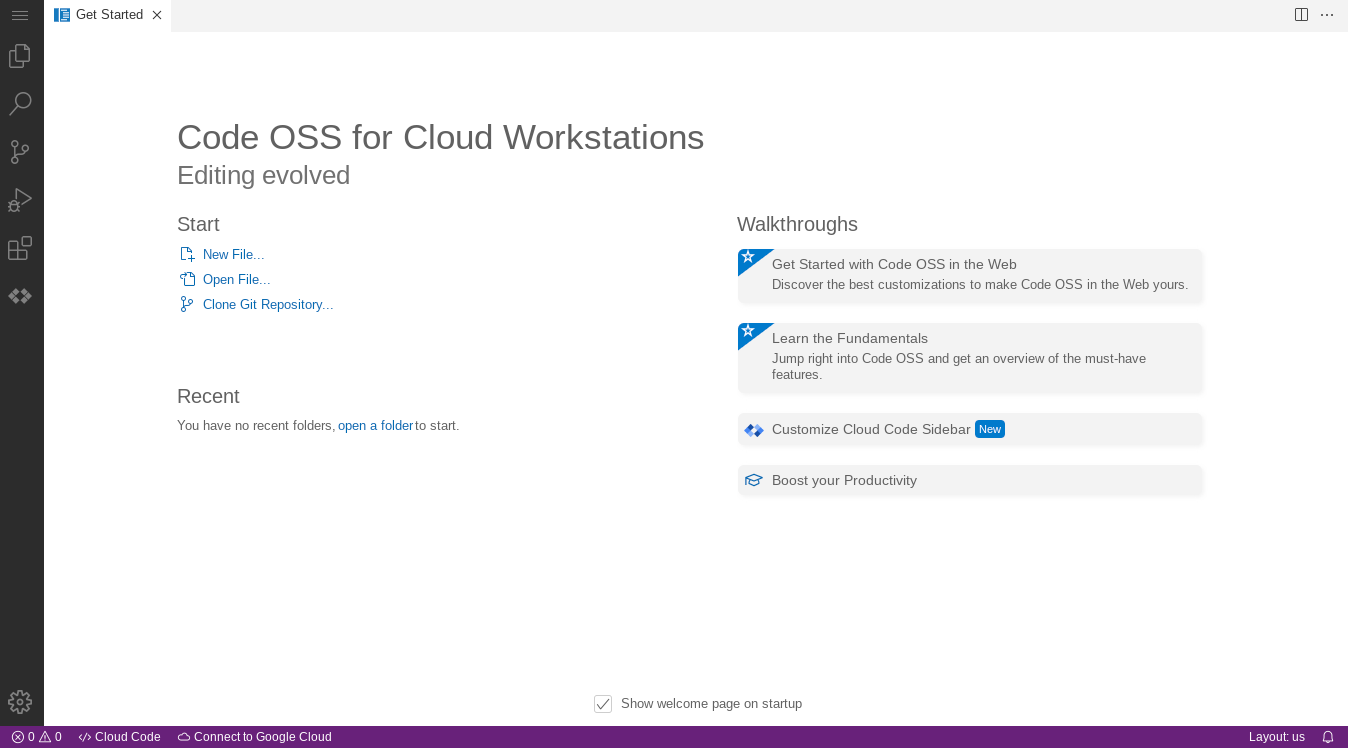
4. The following example shows the welcome page for the Cloud Workstations
[base editor](https://docs.cloud.google.com/workstations/docs/base-editor-overview).
Your page might look different, depending on how you define your
workstation configuration:
For more information about connecting through SSH, see
[SSH support](https://docs.cloud.google.com/workstations/docs/ssh-support).
For more information about connecting to web apps running on your
workstation, see
[Access HTTP servers running on a workstation](https://docs.cloud.google.com/workstations/docs/access-http-servers-running-on-workstations).
## Clean up
To delete a workstation from the Google Cloud console:
1. In the Google Cloud console, go to **Cloud Workstations** \> **Workstations**.
2. Select the checkbox beside the workstation that you want to delete.
3. Click themore_vert**More** options menu and select **Delete** to delete the selected workstation.
If your workstation configuration uses persistent disks and the
[reclaim policy](https://docs.cloud.google.com/workstations/docs/reference/rest/v1/projects.locations.workstationClusters.workstationConfigs#reclaimpolicy)
is set to retain persistent disks after you delete the workstation, be sure to
remind your Cloud Workstations Admin to manually delete the
persistent disk for you.
For more about deleting workstation configurations,
workstation clusters, and Google Cloud projects,
see [Delete resources](https://docs.cloud.google.com/workstations/docs/delete-resources).
## What's next
- Use the
[Cloud Workstations base editor](https://docs.cloud.google.com/workstations/docs/base-editor-overview).
- Learn more about configuring additional options in your
[workstation configuration](https://docs.cloud.google.com/workstations/docs/create-configuration).
- Customize your
[workstation configuration](https://docs.cloud.google.com/workstations/docs/customize-development-environment)
through the API.
- Create [customized container images](https://docs.cloud.google.com/workstations/docs/customize-container-images)
that extend the
[preconfigured base images](https://docs.cloud.google.com/workstations/docs/preconfigured-base-images)
provided by Cloud Workstations.